HOCL in Schools
Maintaining a clean and healthy learning environment has become a top priority for schools of all sizes. With students, teachers, and staff sharing classrooms, cafeterias, gyms, and restrooms throughout the day, the potential for germ transmission is constant. As a result, many administrators are reassessing traditional cleaning products and looking for safer, more effective solutions. One option gaining significant attention is HOCL in schools.
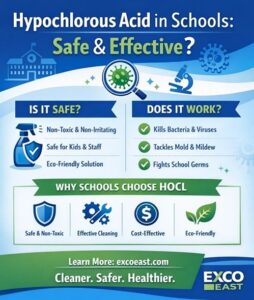
Two questions tend to guide this conversation. First, is hypochlorous acid safe for daily use in schools? Second, does it actually kill the germs that commonly circulate in educational environments? Understanding the answers to these questions helps schools make informed decisions about their sanitation programs.
What Is Hypochlorous Acid and Why Is It Different?
Hypochlorous Acid is a naturally occurring compound produced by the human immune system as part of its defense against harmful microorganisms. When manufactured for sanitation purposes, it is created through a controlled electrolysis process using water, salt, and electricity. This process produces a solution that is both highly effective and remarkably gentle.
Unlike bleach, ammonia, or quaternary disinfectants, hypochlorous acid does not rely on harsh chemicals to achieve results. After application, it breaks down into simple saline, leaving no toxic residue behind. This characteristic makes it especially suitable for indoor environments where children and staff spend extended periods of time.
Is Hypochlorous Acid Safe for Daily Use in Schools?
Safety is often the primary concern when evaluating any disinfectant for educational settings. Research and real-world use indicate that hypochlorous acid safety standards are well aligned with the needs of schools.
HOCL in schools is non toxic and non irritating when properly generated and applied. It does not produce strong fumes or odors that can trigger headaches, asthma symptoms, or allergic reactions. Because of this, it can be used during the school day without requiring room closures or extended ventilation periods.
Another advantage is that surfaces treated with hypochlorous acid can often be used immediately after application. This supports daily school disinfection routines without disrupting instruction or student movement. Custodial teams benefit from faster turnaround times and simpler workflows.
Additionally, using HOCL reduces the need to store and handle multiple hazardous cleaning chemicals. This lowers the risk of accidental exposure, spills, or improper mixing, which are common safety concerns in school facilities.
Does Hypochlorous Acid Kill Common School Germs?
Effectiveness is just as important as safety. Schools need confidence that their disinfectant choices truly address health risks. HOCL in schools has been shown to kill a broad range of pathogens commonly found in educational environments.
It is effective against many bacteria, including E. coli, Salmonella, MRSA, and Streptococcus. It also neutralizes viruses such as influenza and other respiratory pathogens that spread easily in classrooms. In addition, hypochlorous acid targets mold, mildew spores, fungi, and biofilms that can accumulate on surfaces over time.
The way hypochlorous acid works sets it apart from many conventional cleaners. It penetrates microbial cell walls and disrupts essential biological functions, leading to rapid inactivation. This quick action allows schools to maintain high sanitation standards without long dwell times or aggressive chemical exposure. As a result, HOCL in schools supports both efficiency and protection.
Why Schools Are Replacing Traditional Disinfectants
Many schools are transitioning away from traditional products because of long-term concerns related to chemical exposure and environmental impact. HOCL in schools offers a compelling alternative.
Schools that adopt hypochlorous acid often experience:
- Reduced exposure to harsh chemicals
- Improved indoor air quality
- Safer cleaning practices for custodial staff
- Faster room turnover after cleaning
- Lower long-term chemical costs
- More sustainable sanitation programs
These benefits contribute to healthier environments for both students and staff, while also supporting operational efficiency.
How Exco East, LLC Supports Safer School Sanitation
Exco East, LLC works with schools and institutions to implement hypochlorous acid systems designed for consistent, reliable performance. On-site generation allows facilities to produce fresh solution as needed, reducing dependence on supply chains and prepackaged chemicals.
By helping schools integrate hypochlorous acid into their existing cleaning protocols, Exco East, LLC supports safer routines without increasing complexity. Systems are designed to scale, making them suitable for individual schools as well as entire districts.
A Smarter Approach to School Disinfection
Choosing the right disinfectant is no longer just about killing germs. It is about protecting health, supporting learning, and managing long-term risk. HOCL in schools addresses all of these priorities by offering effective germ control without compromising safety.
As schools continue to evolve their cleaning standards, hypochlorous acid stands out as a solution that aligns with modern expectations for health, sustainability, and operational efficiency.
Speak with Exco East, LLC to learn how hypochlorous acid systems can be integrated into your existing sanitation program and help your facility move toward a safer, more sustainable cleaning approach.
Exco East, LLC
3095 Bashor Rd
Conway, SC 29526
843-503-2348
https://excoeast.com/